


Hotel Website Design Trends 2026: Why Your Digital Infrastructure Is the Real Competitive Edge
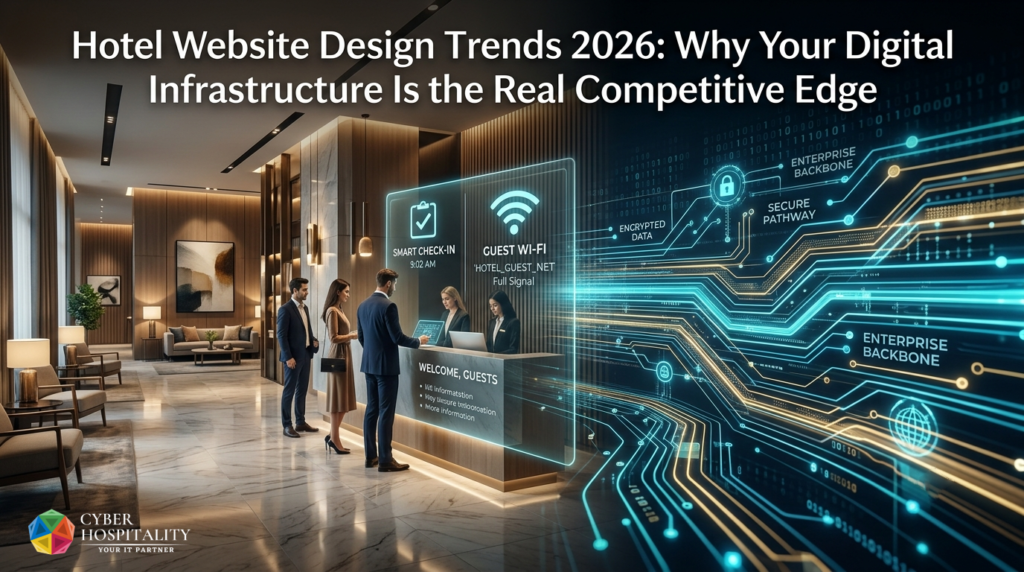
Hotel Website Design Trends 2026: Why Your Digital Infrastructure Is the Real Competitive Edge
Here’s a hard truth that keeps general managers up at night: 74% of hotel guests now rank reliable Wi-Fi as more important than complimentary breakfast, and 67% will leave a negative online review if they experience connectivity issues during their stay with AI in hospitality industry 2026. Meanwhile, the average hotel loses approximately $15,000 annually in direct revenue due to poor digital infrastructure—whether that’s slow booking engines, clunky mobile check-in, or Wi-Fi that buckles under the weight of 40+ connected devices per room.
Welcome to AI in hospitality industry 2026, where the intersection of intelligent automation and robust network management isn’t just a tech conversation—it’s a revenue conversation. The hospitality landscape has shifted dramatically. Guests don’t just want a bed and a minibar anymore. They want seamless digital experiences from the moment they Google your property to the moment they check out via their smartphone. And if your digital backbone can’t support that vision? You’re leaving money on the table.
The New Guest Expectation: Digital-First, Frictionless Always
Let’s paint a picture. It’s 8:47 PM on a Tuesday. Sarah, a business traveler, walks into your lobby after a brutal cross-country flight. Before she even approaches the front desk, she’s already connected to your guest Wi-Fi, pulled up your mobile app, and is streaming a video call with her family back home. She expects her room’s smart thermostat to already know her preferred temperature, expects the AI concierge on your website to have already suggested her favorite type of pillow, expects zero buffering, zero authentication headaches, and zero “please call the front desk” moments.
This isn’t science fiction. This is Tuesday.
The hospitality industry in 2026 has fully embraced Artificial Intelligence as a core operational pillar. Hotels are deploying AI-powered chatbots that handle reservation inquiries at 2 AM. Revenue management algorithms adjust room rates in real-time based on local event data, weather patterns, and competitor pricing. Predictive maintenance systems alert engineering teams about HVAC issues before a guest ever notices the room is two degrees too warm. Housekeeping schedules are optimized by machine learning models that factor in checkout times, room types, and staff availability.
But here’s what most hoteliers miss: none of these AI applications matter if your network can’t handle the load.
A beautiful website with an AI chatbot is worthless if the page takes eight seconds to load on mobile. A smart room with voice-activated controls becomes a punchline if the guest can’t get a stable connection. Dynamic pricing engines can’t sync if your property management system is dropping packets every few minutes. The shiny front-end technology that dominates Hotel Website Design Trends 2026 discussions only works when it’s built on a rock-solid, professionally managed digital infrastructure.
The Hidden Cost of “Good Enough” Wi-Fi
Most hotel owners fall into the same trap. They think Wi-Fi is a checkbox item. “We have internet. Guests can check their email. We’re fine.” But in 2026, “fine” is the enemy of profitable.
Consider what actually happens on your network during peak occupancy:
-
Streaming devices: Every guest room has 2-3 personal devices streaming Netflix, YouTube, or video calls in HD.
-
IoT ecosystem: Smart TVs, digital door locks, thermostats, lighting controls, and occupancy sensors all chatter constantly.
-
Operational systems: Your PMS, POS terminals, IP phones, security cameras, and staff tablets depend on the same network.
-
Guest services: Mobile key access, in-app food ordering, and AI concierge features require persistent, low-latency connections.
A typical mid-sized hotel with 120 rooms can easily see 4,000+ simultaneous device connections during a sold-out night. A consumer-grade router setup—no matter how many extenders you daisy-chain—will crumble under that pressure. And when it crumbles, it doesn’t just cause inconvenience. It causes revenue damage.
Let me share a scenario that plays out more often than you’d think.
The Case of the One-Star Review: A Cautionary Tale
Imagine the Riverside Grand, a boutique 85-room property in a competitive market. They’d recently invested $40,000 in a stunning website redesign following the latest Hotel Website Design Trends 2026—beautiful parallax scrolling, an AI booking assistant, immersive video backgrounds, the works. Their direct booking numbers were climbing. Guest satisfaction scores were trending up. Then came the Memorial Day weekend crush.
By Saturday evening, the property was at 98% occupancy. The lobby was buzzing. The restaurant was packed. And the Wi-Fi had completely collapsed. Guests couldn’t connect their devices. The smart locks on three floors went offline, forcing the front desk to manually program keycards. The POS system in the restaurant started timing out during dinner service. A guest trying to present a digital conference call from his room spent 45 minutes on hold with the front desk, missed his meeting, and checked out early.
By Monday morning, the Riverside Grand had collected four new one-star reviews—all mentioning “terrible Wi-Fi” and “antiquated technology.” Their average rating on OTA platforms dropped from 4.6 to 4.2. Over the following quarter, their direct booking conversion rate fell by 18% as potential guests read those reviews and chose competitors instead. The estimated revenue impact? Just over $62,000 in lost bookings over six months.
The kicker? Their website was gorgeous, AI chatbot was sophisticated, rooms were impeccably designed. But their network infrastructure was an afterthought, and it cost them dearly.
This is why Cyber Hospitality LLC. exists. We don’t just install routers. We architect, monitor, and manage enterprise-grade digital infrastructure specifically engineered for the demands of modern hospitality. When your network is professionally managed, those Memorial Day weekends become stories of seamless operations, not crisis management.
Managed Wi-Fi vs. Traditional DIY: The Real Comparison
If you’re still relying on a basic ISP modem and a handful of consumer access points, you’re not just behind the curve—you’re actively hemorrhaging guest satisfaction. Let’s break down the difference with clear eyes.
Table
| Feature | Traditional DIY Wi-Fi | Professionally Managed Wi-Fi (Cyber Hospitality) |
|---|---|---|
| Network Design | Ad-hoc placement based on guesswork | Heat-mapped, site-surveyed deployment for complete coverage |
| Bandwidth Management | First-come, first-served chaos | Intelligent QoS prioritization—guests, IoT, and ops each get dedicated lanes |
| Security Protocols | Basic WPA2 password, if you’re lucky | Enterprise-grade encryption, VLAN segmentation, guest isolation, and PCI compliance |
| Scalability | Add another router and pray | Seamless expansion as you add rooms, amenities, or smart devices |
| Monitoring & Support | Reactive: “The Wi-Fi is down!” | Proactive 24/7 monitoring with sub-15-minute response times |
| Guest Experience | Frustrating authentication, dead zones | One-click connection, seamless roaming, consistent speeds property-wide |
| Cost Over 5 Years | Lower upfront, massive hidden costs in downtime and reputation | Predictable subscription model with measurable ROI through increased direct bookings |
| Integration with AI Tools | Unreliable—dropped connections break the experience | Optimized for PMS, chatbots, smart room tech, and mobile key systems |
The difference isn’t subtle. It’s the gap between a hotel that guests remember for the right reasons and one they warn their friends about.
Why Bandwidth Management Is Your Secret Weapon
Here’s where we get technical, because this matters. Bandwidth isn’t just about speed—it’s about intelligent allocation. In a modern hotel, not all traffic is created equal.
Your revenue management system pinging for rate updates? That’s business-critical. A guest streaming 4K video? That’s satisfaction-critical. A smart door lock sending a heartbeat signal? That’s security-critical. A housekeeper’s tablet checking room status? That’s operational-critical. When all of these compete on an unmanaged network, something breaks. Usually at the worst possible moment.
Cyber Hospitality’s managed systems use advanced Quality of Service (QoS) protocols to create virtual lanes on your network. Guest traffic gets priority for streaming and video calls. Operational systems get guaranteed bandwidth for real-time synchronization. IoT devices are isolated on secure VLANs so a compromised smart TV can’t become a backdoor into your payment processing system.
This isn’t paranoia. In 2025, the hospitality industry saw a 34% increase in cyberattacks targeting hotel networks, with attackers specifically exploiting poorly secured IoT devices to gain access to guest payment data. A professionally managed network isn’t a luxury—it’s a security imperative.
And from a guest experience perspective, the impact is immediate. When a traveler can walk from the lobby to the elevator to their room to the pool without their video call dropping, without re-authenticating, without thinking about the network at all? That’s when you’ve won, when they leave five-star reviews, when they book direct next time.
Hotel Website Design Trends 2026: The Infrastructure Behind the Aesthetics
Let’s circle back to Hotel Website Design Trends 2026, because this is where many hoteliers get seduced by the surface and forget the foundation.
The trends dominating hospitality web design this year are genuinely exciting. We’re seeing:
-
AI-driven personalization engines that serve different homepage experiences to business travelers versus leisure families
-
Immersive 3D virtual tours with WebGL rendering that let guests “walk” their room before booking
-
Voice-search optimization so guests can find your property by asking Siri or Alexa for “pet-friendly boutique hotels near downtown”
-
Progressive Web Apps (PWAs) that load instantly, work offline, and feel like native mobile apps
-
Predictive booking interfaces that suggest dates and room types based on the visitor’s browsing behavior
All of these trends are brilliant. All of them drive conversion. And all of them demand robust, low-latency, high-availability network infrastructure to function properly.
That immersive 3D room tour? It’ll buffer endlessly on a slow connection, and 53% of mobile users abandon a site that takes more than three seconds to load. The AI chatbot? It needs persistent API connections to your PMS and CRM—connections that fail if your network is unstable. The PWA? It pre-caches content, but the initial load still requires bandwidth, and every subsequent interaction needs a reliable pipe.
This is why Cyber Hospitality LLC. approaches hotel digital infrastructure holistically. We don’t just ask, “Do you have Wi-Fi?” We ask, “Can your network support the guest experience you’re promising on your website?” Because if the answer is no, you’re not just losing technical credibility—you’re losing trust. And in hospitality, trust is the only currency that matters.
The ROI of Professional Network Management
Let’s talk numbers, because at the end of the day, this is a business decision.
When you partner with Cyber Hospitality for professional Wi-Fi management, the return on investment manifests in several measurable ways:
Increased Direct Bookings: Hotels with fast, reliable websites and seamless mobile experiences convert 20-35% more direct bookings than those with sluggish digital touchpoints. At an average commission savings of 15-18% per OTA booking, that adds up fast.
Reduced Negative Reviews: A single one-star review mentioning Wi-Fi can cost you dozens of potential bookings. Professional network management virtually eliminates connectivity-related complaints.
Operational Efficiency: Staff spend less time troubleshooting guest Wi-Fi issues (front desk agents waste an average of 47 minutes per shift on tech support) and more time delivering actual hospitality.
Extended Asset Lifespan: Enterprise-grade equipment managed by professionals lasts 3-4 years longer than consumer gear pushed beyond its limits. Plus, you avoid the capital expense of constant rip-and-replace cycles.
Cybersecurity Risk Mitigation: The average data breach in hospitality costs $3.4 million in fines, legal fees, and reputational damage. Proper network segmentation and monitoring are your first line of defense.
Future-Proofing: As you add smart room technology, AI concierge services, and mobile key systems, your network scales effortlessly rather than requiring costly overhauls.
The math is straightforward. For most properties, the cost of professional Wi-Fi management pays for itself within the first quarter through increased direct bookings alone. Everything else—happier guests, more efficient staff, better security—is gravy.
What “Guest Experience” Actually Means in 2026
The phrase “guest experience” gets thrown around so much it’s become almost meaningless. So let’s define it precisely.
In 2026, guest experience is the sum total of every digital and physical interaction a traveler has with your property, from awareness to post-stay. It’s:
-
Finding your hotel through a voice search and having your website load instantly on their phone
-
Using an AI chatbot to ask about pet policies at midnight and getting an accurate, helpful response in under two seconds
-
Walking into your lobby and connecting to guest Wi-Fi without typing a 16-character password
-
Entering their room and having the lights, temperature, and entertainment system already aligned with their preferences
-
Ordering room service through your app and receiving it in 18 minutes because the kitchen got the order instantly
-
Checking out via mobile, receiving their folio by email, and getting a personalized “see you next time” message
Every single one of these moments depends on your network. Not just your website. Not just your app. Your network. The invisible plumbing that guests never think about until it fails.
At Cyber Hospitality, we make sure they never have to think about it. Because when your digital infrastructure is truly professional, it disappears. It becomes invisible, reliable, and effortless—just like great hospitality should be.
Integration Is Everything: Your PMS, Your AI, Your Network
One of the most common mistakes we see is hotels investing in AI tools and modern website features without considering integration architecture. You buy an AI chatbot from Vendor A, a revenue management system from Vendor B, a mobile key solution from Vendor C, and a website from Vendor D. None of them talk to each other properly. Your PMS becomes a bottleneck, network gets congested with conflicting API calls, staff ends up managing four different dashboards.
Cyber Hospitality’s approach is different. We design network infrastructure that serves as the connective tissue for your entire technology stack. Our systems are optimized for seamless integration with major PMS platforms, AI concierge tools, and smart property technologies. We don’t just provide bandwidth—we provide bandwidth intelligence, ensuring that your technology investments actually deliver the ROI they promised in the sales demo.
This is particularly critical as AI adoption accelerates. Hotels are now using:
-
Predictive analytics to forecast occupancy with 94% accuracy
-
Dynamic pricing algorithms that adjust rates 48 times per day based on real-time demand signals
-
AI-powered housekeeping optimization that routes staff based on checkout patterns and room priority
-
Smart maintenance systems that predict HVAC failures before they happen
All of these systems require constant, reliable data flow. A network hiccup doesn’t just mean a guest can’t stream Netflix—it means your revenue management system misses a pricing opportunity, or your maintenance alert never reaches the engineering team. The cost of poor connectivity extends far beyond guest complaints.
Final Thoughts: Build the Foundation Before the Facade
The hospitality industry in 2026 is more technologically sophisticated than ever before. AI is transforming operations. Website design is becoming more immersive and personalized. Guest expectations are skyrocketing. But none of these advancements matter if they’re built on a crumbling digital foundation.
Hotel Website Design Trends 2026 will continue to evolve. New AI tools will emerge. Guest preferences will shift. But the one constant will be this: properties with professionally managed, secure, scalable network infrastructure will outperform those without it, every single time.
At Cyber Hospitality LLC., we don’t sell routers. We sell peace of mind, sell the confidence that when a guest walks through your doors, their digital experience will be as polished and professional as your physical one, sell the assurance that your staff can focus on hospitality instead of tech support. Also we sell the infrastructure that turns your technology investments into actual revenue.
If you’re ready to stop treating Wi-Fi as an afterthought and start treating it as a competitive advantage, we’re ready to help. Visit us at Cyber Hospitality or call us at +1 (307) 683-1600. Let’s build something that actually works.
Frequently Asked Questions
Q1: How is professional hotel Wi-Fi management different from just getting a faster internet plan from my ISP?
A faster internet plan gives you more raw bandwidth, but it doesn’t solve the distribution problem. Professional Wi-Fi management from Cyber Hospitality involves enterprise-grade hardware placement based on site surveys, intelligent Quality of Service (QoS) to prioritize critical traffic, VLAN segmentation for security, 24/7 proactive monitoring, and seamless scalability. An ISP plan is just a bigger pipe—we’re the entire plumbing system, pressure regulators, and maintenance crew.
Q2: Can managed Wi-Fi actually improve my direct booking numbers?
Absolutely. Direct bookings are heavily influenced by your digital touchpoints: website speed, mobile experience, and app functionality. Slow or unreliable connectivity degrades all of these. Hotels with professionally managed networks see 20-35% higher direct booking conversion rates because their digital experiences actually work as designed. Plus, positive reviews mentioning “great Wi-Fi” and “seamless technology” drive more organic traffic.
Q3: Is my current network secure enough for AI tools and smart room technology?
Probably not, if you’re using consumer-grade equipment. Modern hospitality networks need enterprise-level security including VLAN isolation (so guest devices can’t access operational systems), WPA3 encryption, regular firmware updates, intrusion detection, and PCI compliance for payment processing. Cyber Hospitality builds security into the network architecture from day one, which is essential when you’re connecting dozens of IoT devices per room.
Q4: How long does it take to transition from a DIY setup to a professionally managed network?
For a typical 80-150 room property, the transition takes 2-4 weeks from initial site survey to full deployment. This includes a comprehensive heat-mapping survey, hardware installation, network configuration, integration testing with your existing PMS and AI tools, and staff training. Cyber Hospitality minimizes disruption by scheduling work during low-occupancy periods and ensuring no guest-facing downtime during the cutover.
Q5: What happens if there’s a network issue in the middle of the night?
With Cyber Hospitality’s managed services, you have 24/7 proactive monitoring and support. Our systems detect anomalies before they become outages, and our response time averages under 15 minutes. Compare that to the DIY approach where the first sign of trouble is a guest complaint at the front desk, followed by a frantic call to an ISP help desk where you’re ticket number 4,847. Night-shift staff should focus on guests, not troubleshooting router lights.
