


Stop Relying on Cookies: Your Venue Wi-Fi is Your First-Party Data Engine
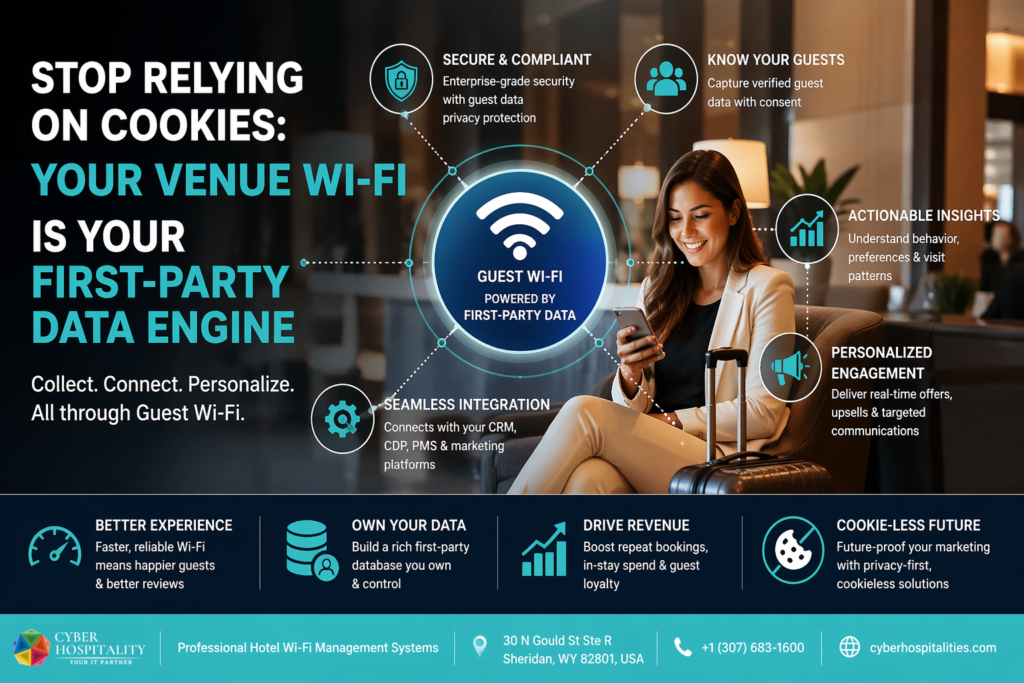
Stop Relying on Cookies: Your Venue Wi-Fi is Your First-Party Data Engine
The writing has been on the wall for a while now. Third-party cookies are fading out, privacy regulations are tightening globally, and customers are becoming far more selective about how—and where—they share their data. At the same time, hospitality benchmarks show that over 90% of hotel guests consider reliable Wi-Fi as important as room cleanliness, while nearly 70% expect personalized experiences during their stay. That’s a massive gap—and an opportunity.
This is exactly where Your Venue Wi-Fi is Your First-Party Data Engine becomes more than just a buzz phrase. It’s a strategic pivot. If you’re still relying on third-party tracking or fragmented data sources, you’re essentially flying blind in a market that now demands precision.
Let’s unpack how your Wi-Fi network—when managed correctly—can become the most valuable data asset your venue owns.
Why Third-Party Cookies Are Losing Their Grip
The decline of third-party cookies isn’t just a technical shift—it’s a fundamental change in how digital marketing operates.
- Browsers like Chrome, Safari, and Firefox are restricting or eliminating cookie tracking
- Privacy laws like GDPR and CCPA are enforcing stricter consent requirements
- Consumers are actively opting out of data tracking
This means traditional retargeting, audience profiling, and attribution models are becoming unreliable.
So what replaces them?
You guessed it: Your Venue Wi-Fi is Your First-Party Data Engine.
Unlike cookies, Wi-Fi data is:
- Consent-based
- Directly collected
- Highly contextual
- Tied to real-world behavior
That’s a game-changer.
The Untapped Power of Guest Wi-Fi
Most hotels still treat Wi-Fi as a utility—like electricity or water. Necessary, but not strategic.
That’s a mistake.
When engineered properly, your Wi-Fi network becomes a data collection, engagement, and personalization platform.
Here’s what modern guest Wi-Fi can capture (with consent):
- Email addresses and verified identities
- Visit frequency and dwell time
- Device types and usage patterns
- On-property movement (via access points)
- Engagement with captive portals and offers
This is first-party data gold—and it’s fully compliant when handled correctly.
From Connectivity to Conversion: How It Works
Let’s break down the journey:
- Guest Connects to Wi-Fi
A branded captive portal appears—clean, fast, and mobile-optimized. - Data Capture (With Consent)
Guests log in via email, social, or room number authentication. - Data Enrichment
Integrate with your CRM or CDP to build richer guest profiles. - Real-Time Engagement
Trigger personalized offers, upsells, or loyalty incentives. - Post-Stay Marketing
Continue communication through email campaigns or remarketing.
This entire funnel is powered by one simple truth:
Your Venue Wi-Fi is Your First-Party Data Engine.
Technical Backbone: What Makes It Work
Let’s get into the nuts and bolts—because this is where most DIY setups fall short.
1. Network Security
A poorly secured Wi-Fi network is a liability.
A managed system ensures:
- WPA3 encryption
- VLAN segmentation between guest and internal networks
- Firewall protection and intrusion detection
- Compliance with data privacy regulations
This protects both your guests and your brand reputation.
2. Bandwidth Management
Nothing kills guest satisfaction faster than slow Wi-Fi.
Advanced systems provide:
- Dynamic bandwidth allocation
- Traffic shaping for high-priority services
- Load balancing across access points
- Real-time performance monitoring
This ensures a seamless experience—even during peak occupancy.
3. Captive Portal Optimization
Your login page isn’t just a gateway—it’s your first impression.
A high-performing captive portal should:
- Load instantly
- Reflect your brand identity
- Offer multiple login options
- Capture clean, structured data
Done right, it converts anonymous users into known guests.
4. Integration with CDPs and CRMs
This is where the magic happens.
Wi-Fi data feeds directly into:
- Customer Data Platforms (CDPs)
- Email marketing tools (like Mailchimp or Klaviyo)
- PMS and booking systems
Now you’re not just collecting data—you’re activating it.
Managed Wi-Fi vs. DIY Wi-Fi: A Reality Check
| Feature | Managed Wi-Fi (Cyber Hospitality) | Traditional DIY Wi-Fi |
|---|---|---|
| Data Collection | Structured, compliant, actionable | Minimal or fragmented |
| Security | Enterprise-grade | Basic or inconsistent |
| Bandwidth Optimization | Automated and dynamic | Manual or limited |
| Guest Experience | Seamless and branded | Generic and unreliable |
| Marketing Integration | Full CRM/CDP sync | Rare or non-existent |
| Support | 24/7 monitoring and optimization | Reactive troubleshooting |
If you’re serious about leveraging Your Venue Wi-Fi is Your First-Party Data Engine, DIY simply won’t cut it.
A “What If” Scenario: The Cost of Poor Wi-Fi
Imagine this:
A business traveler checks into your hotel after a long day. They need to join a critical Zoom call.
- The Wi-Fi login page takes forever to load
- The connection drops twice during the meeting
- Video buffering makes communication painful
Frustrated, they leave a review:
“Great location, decent rooms—but the Wi-Fi was unusable. Won’t stay again.”
That one review doesn’t just hurt your rating—it impacts future bookings.
Now flip the scenario:
- Instant login
- Rock-solid connection
- Personalized welcome message with a discount for the hotel bar
Same guest. Completely different outcome.
That’s the difference between treating Wi-Fi as infrastructure vs. strategy.
Case Study Style Insight: Turning Wi-Fi into Revenue
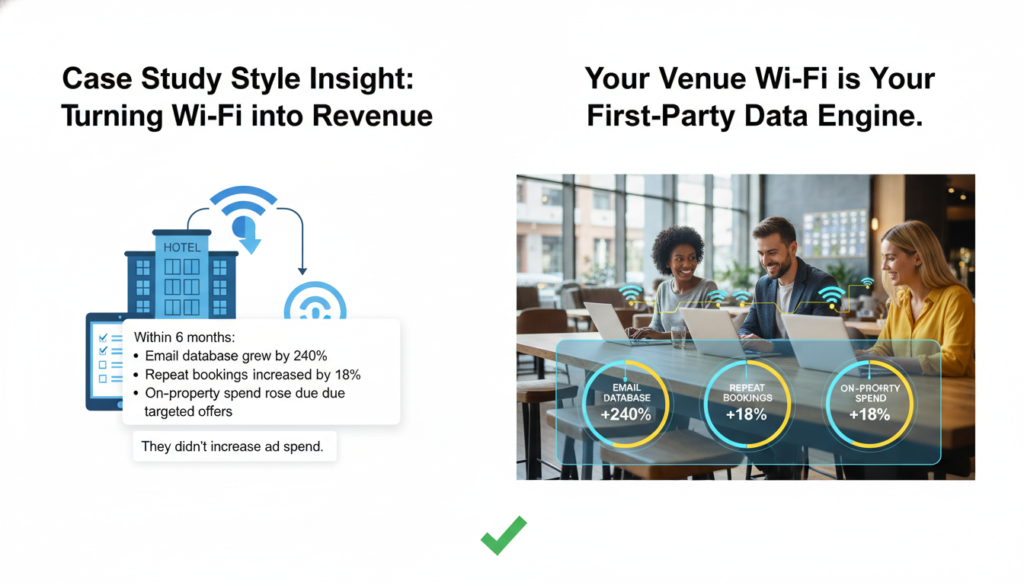
A mid-sized hotel group implemented a managed Wi-Fi solution with full data integration.
Within 6 months:
- Email database grew by 240%
- Repeat bookings increased by 18%
- On-property spend rose due to targeted offers
The kicker?
They didn’t increase ad spend.
They simply leveraged what they already had:
Your Venue Wi-Fi is Your First-Party Data Engine.
Guest Experience: The Hidden ROI Driver
Let’s not forget the human side.
Guests don’t care about your backend systems. They care about:
- Speed
- Reliability
- Ease of access
But behind the scenes, every seamless connection feeds your data ecosystem.
That’s the beauty of it—you’re enhancing experience and collecting insights simultaneously.
Why Cyber Hospitality LLC Is Built for This
Here’s the blunt truth:
Most hotels don’t have the internal expertise to manage this level of infrastructure.
That’s where Cyber Hospitality LLC comes in.
They specialize in:
- End-to-end Wi-Fi network design and deployment
- Advanced bandwidth and device management
- Secure, compliant data capture systems
- Integration with marketing and analytics platforms
This isn’t just IT support—it’s revenue infrastructure.
Key Benefits at a Glance
By embracing Your Venue Wi-Fi is Your First-Party Data Engine, you unlock:
- Privacy-compliant data collection
- Improved guest satisfaction and reviews
- Higher repeat bookings
- Better marketing ROI without third-party cookies
- Real-time personalization capabilities
It’s not an upgrade. It’s a necessity.
Final Thoughts
The hospitality industry is at a crossroads.
You can continue relying on outdated tracking methods—or you can take control of your data ecosystem.
The smartest operators are already making the shift.
Because at the end of the day, Your Venue Wi-Fi is Your First-Party Data Engine—and it’s the most underutilized asset in your property.
FAQ Section
1. What is first-party data in hospitality?
First-party data is information collected directly from your guests, such as email addresses, preferences, and behavior on your property. It’s more reliable and privacy-compliant than third-party data.
2. How does Wi-Fi help collect guest data?
Through captive portals and login systems, Wi-Fi networks can securely collect guest information with consent, enabling personalized marketing and improved service delivery.
3. Is collecting data via Wi-Fi compliant with privacy laws?
Yes, as long as proper consent mechanisms, data storage policies, and security measures are in place—something managed providers like Cyber Hospitality ensure.
4. Can Wi-Fi data integrate with marketing platforms?
Absolutely. Modern systems integrate with CRMs, CDPs, and email tools, allowing automated campaigns and real-time personalization.
5. Why is managed Wi-Fi better than DIY solutions?
Managed Wi-Fi offers enterprise-grade security, better performance, continuous monitoring, and seamless integration with marketing tools—something DIY setups rarely achieve.
