


WiFi Login: Turn Guest Access into Marketing Power
WiFi Login: Turn Guest Access into Marketing Power
Introduction: Where Connectivity Meets Conversion
In today’s hospitality landscape, Wi-Fi is no longer a “nice-to-have”—it’s the backbone of guest experience and revenue growth. Consider this:
- Over 90% of hotel guests rate Wi-Fi quality as a top factor in their overall satisfaction.
- Nearly 70% of travelers are less likely to return after experiencing poor connectivity.
- And perhaps most importantly, hotels leveraging smart Wi-Fi systems see up to 3x higher guest engagement rates.
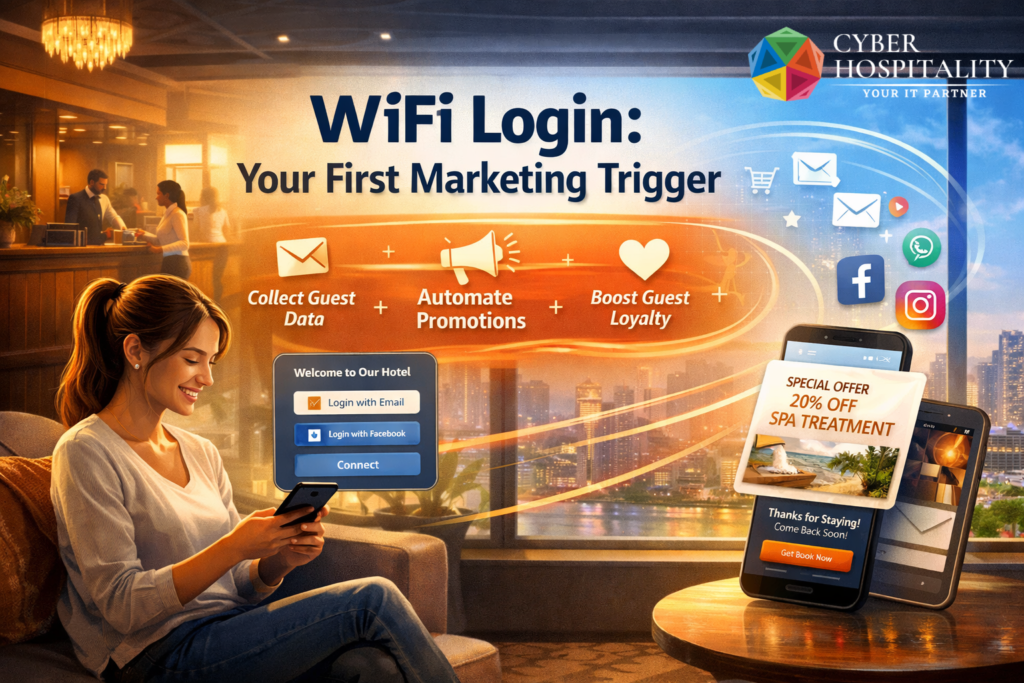
This is where WiFi Login: Your First Marketing Trigger becomes more than just a catchy phrase—it becomes a strategic advantage. The moment a guest connects to your network is not just a technical handshake; it’s your first opportunity to start a relationship, gather insights, and initiate personalized marketing journeys.
In this article, we’ll unpack how WiFi Login: Your First Marketing Trigger transforms anonymous users into loyal guests, while also addressing the technical backbone—security, bandwidth optimization, and seamless user experience—that makes it all possible.
Why WiFi Login Is More Than Just Access
When a guest logs into your Wi-Fi, they’re doing more than checking emails or streaming content—they’re opening a digital doorway into your brand ecosystem.
Traditional Wi-Fi systems treat this as a utility. Managed systems treat it as a marketing engine.
Here’s what a modern Wi-Fi login can capture:
- Guest email addresses and contact details
- Visit frequency and dwell time
- Device type and usage patterns
- Consent-based marketing preferences
This data becomes the foundation for automated campaigns, targeted offers, and personalized experiences—all triggered from that very first login.
That’s the power of WiFi Login: Your First Marketing Trigger.
The Guest Journey Starts at Login
Let’s walk through a simple scenario.
A guest checks into your hotel after a long flight. The first thing they ask at the front desk?
“What’s the Wi-Fi password?”
Now imagine two different experiences:
Scenario A: Traditional Wi-Fi
- Guest enters a static password
- Gains access
- No engagement, no data capture
- No follow-up after checkout
Scenario B: Smart Wi-Fi Login Portal
- Guest connects to a branded login page
- Logs in via email or social account
- Receives a welcome message with hotel offers
- Gets personalized recommendations during stay
- Receives a post-visit discount email
Same guest. Same Wi-Fi. Completely different outcomes.
That’s how WiFi Login: Your First Marketing Trigger turns a basic service into a revenue-generating channel.
Technical Backbone: What Makes It Work
Behind every seamless Wi-Fi login experience is a robust technical infrastructure. This is where many hotels fall short when relying on DIY setups.
1. Network Security
Guest networks are highly vulnerable if not properly segmented.
A professional system ensures:
- VLAN segmentation between guest and internal networks
- End-to-end encryption for data privacy
- Firewall protection against malicious attacks
- Compliance with global data protection standards
Without these, a simple Wi-Fi login can become a security liability.
2. Bandwidth Management
Ever seen guests complain about buffering during peak hours? That’s poor bandwidth allocation.
Advanced Wi-Fi systems provide:
- Dynamic bandwidth allocation per user
- Traffic shaping for streaming vs. business use
- Load balancing across access points
- Real-time monitoring to prevent congestion
The result? Consistent performance—even at full occupancy.
3. Seamless Guest Experience
A complicated login process can frustrate guests before they even get online.
Modern captive portals offer:
- One-click social logins
- Auto-login for returning guests
- Multilingual interfaces
- Fast authentication without redirects
Because in hospitality, friction equals dissatisfaction.
Comparison: Managed Wi-Fi vs Traditional DIY Wi-Fi
| Feature | Managed Wi-Fi (Cyber Hospitality) | Traditional DIY Wi-Fi |
|---|---|---|
| Guest Data Capture | Advanced & Automated | None or Limited |
| Security | Enterprise-grade | Basic |
| Bandwidth Optimization | Dynamic & Smart | Static |
| Marketing Integration | Built-in automation | Not available |
| Guest Experience | Personalized & branded | Generic |
| Scalability | High | Limited |
| Support | 24/7 professional | Self-managed |
The difference is clear: one is a tool, the other is a strategy.
Case Study Scenario: The Hidden Cost of Poor Wi-Fi
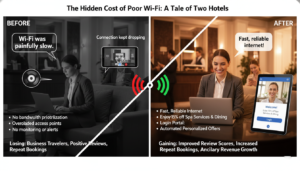
Let’s consider a realistic “what if” scenario.
A boutique hotel in a busy tourist area receives consistent bookings but struggles with repeat guests.
Guest reviews reveal a pattern:
- “Wi-Fi was painfully slow.”
- “Couldn’t join a Zoom call.”
- “Connection kept dropping.”
Now, here’s what’s happening behind the scenes:
- No bandwidth prioritization
- Overloaded access points
- No monitoring or alerts
The hotel is unknowingly losing:
- Business travelers (high-value segment)
- Positive reviews
- Repeat bookings
Now imagine the same property after implementing a managed solution:
- Guests receive fast, reliable internet
- Login portal promotes spa discounts and dining offers
- Automated emails bring guests back with personalized deals
Within months:
- Review scores improve
- Repeat bookings increase
- Ancillary revenue grows
That’s the real-world impact of WiFi Login: Your First Marketing Trigger.
How Cyber Hospitality Turns Wi-Fi Into Revenue
Cyber Hospitality LLC. specializes in transforming hotel Wi-Fi into a strategic asset.
Their approach combines:
- Technical excellence
- Marketing intelligence
- Guest-centric design
Key Advantages
1. Branded Captive Portals
Custom-designed login pages that reflect your brand identity and promote services.
2. Automated Marketing Journeys
Trigger emails and offers based on:
- Check-in
- Length of stay
- Guest preferences
3. Real-Time Analytics
Understand:
- Guest behavior
- Peak usage times
- Engagement metrics
4. Scalable Infrastructure
Whether it’s a boutique hotel or a multi-property chain, the system scales effortlessly.
5. 24/7 Monitoring & Support
Issues are identified and resolved before guests even notice.
The Marketing Flywheel Starts Here
Once you capture guest data at login, the possibilities expand:
- Pre-arrival emails with upsell offers
- In-stay promotions for dining, spa, or events
- Post-stay campaigns to drive repeat visits
- Loyalty program integration
It’s not just about connectivity—it’s about continuity.
And it all begins with WiFi Login: Your First Marketing Trigger.
Common Mistakes Hotels Make
Even well-intentioned properties often miss the mark:
- Treating Wi-Fi as an IT expense instead of a revenue driver
- Using outdated hardware with no scalability
- Ignoring guest data opportunities
- Failing to prioritize security and compliance
These gaps create friction—not just technically, but commercially.
Future Trends: Where Wi-Fi Is Heading
The next evolution of hotel Wi-Fi includes:
- AI-driven personalization
- IoT integration (smart rooms)
- Location-based marketing within properties
- Predictive analytics for guest behavior
Hotels that adopt these early will have a clear competitive edge.
Conclusion: Your First Impression Happens Online
In hospitality, first impressions matter. Increasingly, that first impression happens before the front desk—at the Wi-Fi login screen.
By rethinking Wi-Fi as a strategic touchpoint, hotels can:
- Enhance guest satisfaction
- Drive repeat bookings
- Unlock new revenue streams
With the right partner, like Cyber Hospitality, this transformation becomes not only possible—but scalable and measurable.
Because in today’s digital-first world, WiFi Login: Your First Marketing Trigger isn’t optional—it’s essential.
FAQs
1. How does WiFi login help in hotel marketing?
WiFi login captures guest data such as email and preferences, enabling personalized marketing campaigns like offers, reminders, and loyalty programs.
2. Is guest data collected through WiFi secure?
Yes, when managed professionally. Systems like those from Cyber Hospitality use encryption, secure authentication, and compliance protocols to protect user data.
3. Can small hotels benefit from managed Wi-Fi systems?
Absolutely. Even smaller properties can increase guest satisfaction and revenue through better connectivity and targeted marketing.
4. What is a captive portal in hotel Wi-Fi?
A captive portal is the branded login page guests see before accessing Wi-Fi. It’s used for authentication, branding, and marketing engagement.
5. How does bandwidth management improve guest experience?
It ensures fair distribution of internet speed, preventing slowdowns during peak usage and maintaining consistent performance.
